The UAE's climate presents one of the world's most challenging environments for gardeners. With average summer temperatures exceeding 40°C, annual rainfall rarely exceeding 120mm, and soil that is predominantly sandy and nutrient-poor, choosing the right plants is the single most impactful decision you can make for your UAE garden. The good news: the region is home to — and highly compatible with — a remarkable range of beautiful, resilient plants that thrive with minimal water.
As a horticulturist working in UAE gardens for over a decade, I've tested hundreds of plant varieties across the Emirates. This guide covers the best performers — plants that deliver genuine garden beauty while demanding far less water than their tropical counterparts.
Native UAE Plants: The Ultimate in Desert Adaptation
Native plants are, by definition, perfectly adapted to UAE conditions. They've evolved to thrive in the local soil, climate, and ecology. Using native plants isn't just ecologically responsible — it's also practical, since they generally require minimal care once established.
Ghaf Tree (Prosopis cineraria) — UAE's National Tree
The Ghaf is the UAE's national tree and perhaps the most impressive example of desert adaptation in the plant world. Its deep root system can reach underground water sources 30 metres below the surface, making it truly independent of surface irrigation once established. The Ghaf provides valuable shade with its feathery canopy, produces small yellow flowers, and its pods are edible — historically an important food source for both animals and people in the region.
Ghaf grows slowly but steadily, eventually reaching 5–10 metres in height. For large garden spaces or as a focal shade tree, it's an excellent long-term investment. Establishment takes 2–3 years, during which time regular watering is needed. After that, it thrives entirely on natural rainfall in most UAE locations.
Sidr / Lote Tree (Ziziphus spina-christi)
The Sidr is a sacred tree with deep cultural and religious significance across the Arab world. It produces small, apple-flavoured fruits, provides dense shade, and is extraordinarily drought-resistant once established. Its thorny branches also make it an excellent natural security hedge. Sidr honey — produced by bees that feed on Sidr flowers — is prized as one of the world's most valuable honeys.
In the garden, Sidr works beautifully as a specimen tree or for creating naturalistic desert landscapes. It tolerates poor, sandy soil, heat, and long dry periods. Water it weekly in its first year; after that, monthly deep watering is usually sufficient.
Farfar / Sodom's Apple (Calotropis procera)
A UAE native that many homeowners overlook due to its wild appearance, Farfar is actually a structurally interesting shrub with silvery-grey leaves and unusual purple-and-white flowers. It's toxic if ingested but poses no contact hazard, and it serves as important habitat for native insects. As a structural element in naturalistic desert gardens, it adds genuine character. Water needs: minimal once established.
Senna (Cassia italica)
Senna is a beautiful flowering native shrub with bright yellow flowers that bloom prolifically in spring and again in autumn. Growing to 1–2 metres, it's perfect for mixed shrub borders and requires very little water once established. It's also medicinally used traditionally across the region. Plant in full sun in well-draining soil.
Drought-Tolerant Ornamentals: Beauty Without Water Waste
Desert Rose (Adenium obesum)
Desert Rose is, in my opinion, the queen of UAE ornamental plants. Its thick, sculptural trunk stores water, allowing it to survive extended dry periods. The flowers — ranging from white through pink to deep crimson — are stunning against the woody trunk, and they bloom prolifically through spring, autumn, and even winter in the UAE. In summer, Adenium goes semi-dormant; reduce watering to once every 10–14 days and enjoy the interesting silhouette.
Desert Rose grows well in containers, allowing you to position it as a focal point on patios or entranceways. Use a very free-draining mix — equal parts coarse sand, perlite, and potting mix. Overwatering is the primary cause of death in UAE Adeniums.
Bougainvillea
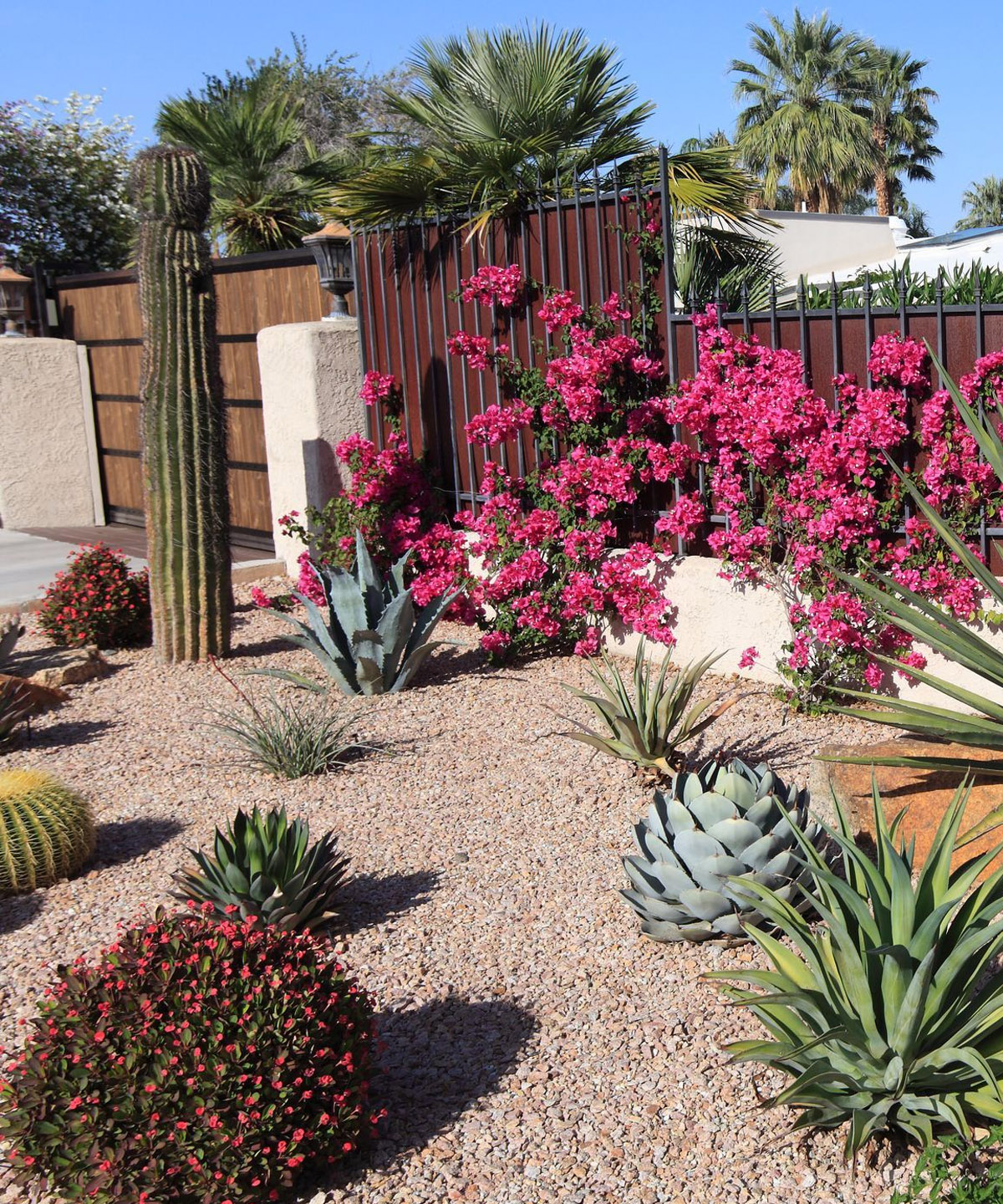
UAE FavouriteThe most widely planted ornamental climber in the UAE, and for excellent reason. Bougainvillea produces spectacular colour (the 'flowers' are actually bracts — modified leaves) and becomes increasingly drought-tolerant as it matures. Stress it slightly with less water to maximise flowering. Available in crimson, magenta, orange, yellow, white, and bicolour varieties.
Plumbago auriculata
Blue BeautyOne of the very few true blue-flowering shrubs available for UAE gardens. Plumbago is fast-growing, heat-tolerant, and produces masses of sky-blue or white flowers almost year-round. It works beautifully as a hedge, a backdrop to other plantings, or left to scramble over fences. Moderate drought tolerance once established.
Lantana camara
Butterfly MagnetPractically indestructible in UAE conditions, Lantana produces multi-coloured flower clusters in yellow, orange, red, and pink — often all on the same plant. It blooms almost continuously in warm weather, attracts butterflies and birds, and thrives with minimal water. Use it as a groundcover, low hedge, or container specimen.
Agave
ArchitecturalAgaves are the ultimate architectural drought-tolerant plants for modern UAE gardens. Their bold, sculptural rosettes in blue-grey, green, or striped forms make dramatic focal points. They store water in their thick leaves and can tolerate months without irrigation. Perfect in gravel gardens, contemporary xeriscapes, and container displays.
"The biggest mistake UAE gardeners make is choosing plants based on how they look in a nursery — often with flowers in full bloom and regular watering behind them. The question to ask is: 'What does this plant look like in August after two weeks without water?' Native and truly adapted plants answer that question confidently."
— Priya Sharma, Senior Horticulturist, Yad Al Ma
Succulents and Cacti for UAE Conditions
Succulents store water in their leaves, stems, or roots, making them ideally suited to the UAE's dry climate. While many cacti are native to the Americas rather than Arabia, they adapt remarkably well to UAE conditions and have become popular elements in contemporary desert garden designs.
Aloe vera
Perhaps the most useful succulent for UAE gardens, Aloe vera has both ornamental and medicinal value. It grows in clumps of fleshy, spine-edged leaves and produces tall orange flower spikes in winter. Completely drought-tolerant once established, it thrives in containers on balconies and patios as well as in open garden beds.
Portulacaria afra (Elephant Bush)
Often mistaken for a small-leafed Jade Plant, Portulacaria is an excellent structural succulent for UAE gardens. It grows as a dense, spreading shrub and is significantly more drought-tolerant than most succulents. In South Africa — its home region — it provides food for elephants; in UAE gardens, it provides reliable, low-maintenance structure. Tolerates coastal conditions well.
Euphorbia milii (Crown of Thorns)
A thorny succulent shrub that produces small but vivid red, pink, or yellow flowers nearly year-round in UAE conditions. It's highly drought-tolerant, thrives in full sun, and makes an effective security hedge due to its sharp spines. Note that the milky sap is a skin and eye irritant — wear gloves when pruning.
Palms: The Iconic UAE Garden Tree
No UAE garden feels complete without at least one palm. Beyond their aesthetic value, palms are well-adapted to the local climate — but their water needs vary considerably between species.
Date Palm (Phoenix dactylifera)
The Date Palm is the UAE's most iconic tree and one of the most drought-tolerant palms available. Once established, it can survive on rainfall alone in many UAE locations. Female trees produce dates — a significant bonus. Its formal, upright growth habit makes it ideal for avenues and formal garden designs. Slow to grow but extremely long-lived — some date palms in the region are hundreds of years old.
Washingtonia Palm (Washingtonia robusta / W. filifera)
The tall, slender Washingtonian palm is widely used in Dubai streetscapes and is well-adapted to UAE conditions. It's fast-growing (for a palm), reaching 15–25 metres, and is appropriately used as a skyline element rather than a garden shade tree. Water requirements are moderate — more than the Date Palm, but considerably less than tropical species.
Groundcovers That Suppress Weeds and Conserve Water
Gazania rigens
Gazania produces striking daisy-like flowers in shades of orange, yellow, red, and white — often with striking dark centres. It's extremely drought-tolerant, loves full sun, and creates a carpet of colour with minimal water. Use it in sunny, well-drained borders. It may go dormant in extreme summer heat but rebounds strongly in autumn.
Portulaca grandiflora (Moss Rose)
Portulaca is a groundcover annual that self-seeds freely, producing brilliant jewel-coloured flowers in rose, yellow, orange, and white throughout the hot months. It's one of the few plants that actually performs better in summer heat and is near-impossible to kill through drought. Scatter seeds in bare areas and let it fill in — it will reward you generously with minimal effort.
Ice Plant (Carpobrotus edulis)
A succulent groundcover with thick, triangular leaves and large, daisy-like flowers in purple-pink or yellow. Ice Plant is excellent for slopes, banks, and coastal gardens — it tolerates salt spray, poor soil, full sun, and extended drought. It creates a weed-suppressing mat and its flowers are genuinely beautiful.
Companion Planting for Water Efficiency
Strategic companion planting — grouping plants with similar water needs together — is essential for irrigation efficiency. In practice, this means creating distinct zones in your garden: a very low-water zone for cacti, succulents, and xeriscape plants; a low-water zone for established native and adapted ornamentals; and a moderate-water zone for any lush planting you wish to maintain.
Within each zone, taller plants can provide partial shade for more vulnerable companions. Planting Plumbago behind Portulaca, for example, gives the lower plant some afternoon shade protection while the Plumbago's more open canopy benefits from the groundcover's moisture retention below.
Establishment Care: The First Two Years Are Critical
Even the most drought-tolerant plants need consistent moisture during their establishment period — typically 6–24 months depending on species and planting time. The best time to plant drought-tolerant species in the UAE is October through February, when cooler temperatures give roots time to establish before summer stress arrives.
During establishment, water deeply but infrequently — this encourages roots to grow deeper in search of moisture, creating a more drought-resilient plant. Watering lightly and frequently produces shallow root systems that struggle when irrigation is reduced.