Water is one of the most precious — and expensive — resources in the UAE. With DEWA rates structured to encourage conservation and summer garden water demand running two to three times higher than cooler months, a smart irrigation system isn't just an environmental choice. It's a sound financial investment that typically pays for itself within 18–24 months.
Having installed hundreds of irrigation systems across Dubai, Sharjah, and Abu Dhabi, our team at Yad Al Ma has seen the dramatic difference the right system makes. This guide covers everything you need to know — from system types and smart controllers to ROI calculations and seasonal scheduling.
Why Dubai Gardens Need Smart Irrigation
Residential gardens in Dubai consume, on average, 40–60% of a household's total water usage during the summer months. Much of this is wasted through inefficient scheduling, evaporation, and overwatering — a problem made worse by traditional timer-based controllers that water regardless of whether it rained, regardless of soil moisture levels, and regardless of the actual evapotranspiration rate on any given day.
DEWA's progressive tariff structure means water costs increase significantly as consumption rises. High-consuming households quickly move into the upper pricing tiers, where each unit of water costs considerably more. Smart irrigation keeps consumption in the lower, more economical tiers.
Types of Irrigation Systems Explained
1. Drip Irrigation
Drip irrigation is the most water-efficient method available for garden beds, shrubs, and trees. Water is delivered slowly and directly to the root zone through a network of low-pressure emitters, eliminating evaporation and run-off almost entirely.
A well-designed drip system achieves water efficiency of 90–95%, compared to 60–75% for conventional spray heads. For planted beds, borders, and individual trees, drip irrigation is almost always the right choice in UAE conditions. It also keeps foliage dry, reducing fungal disease risk.
2. Sprinkler/Rotary Head Systems
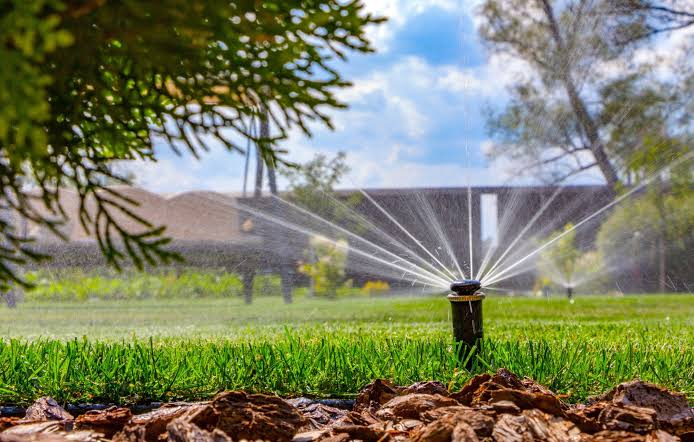
Conventional spray heads and rotary sprinklers remain appropriate for large lawn areas where precise root-zone delivery isn't practical. However, they should be scheduled carefully to minimise evaporation — ideally running only in the early morning hours before temperatures rise.
Modern high-efficiency rotary nozzles (such as MP Rotator heads) apply water at a much lower precipitation rate than standard spray heads, allowing better soil absorption and reducing run-off by up to 35%.
3. Subsurface Drip Irrigation (SDI)
The most efficient irrigation method available, SDI buries drip lines 15–20 cm below the soil surface. This eliminates surface evaporation entirely and delivers water directly to the root zone. SDI is increasingly popular for high-end residential lawns and sports turf in the UAE, achieving efficiency rates above 95%.
Installation cost is higher than surface drip, but water savings and the elimination of surface lines (which degrade in UV exposure) often make it the most cost-effective long-term solution for premium lawns.
4. Micro-Spray and Misting Systems
Micro-sprays are appropriate for closely-spaced ground cover plantings and raised garden beds where full drip coverage would require too many emitters. They're also used for germinating seeds and establishing new plantings where gentle, even coverage is needed.
| System Type | Efficiency | Best For | Installation Cost |
|---|---|---|---|
| Drip Irrigation | 90–95% | Beds, shrubs, trees | Medium |
| Subsurface Drip | 95%+ | Lawns, turf areas | High |
| Rotary Heads | 65–75% | Large lawn areas | Medium |
| Standard Spray | 55–65% | Small lawns | Low–Medium |
| Micro-Spray | 80–85% | Groundcover, seedlings | Medium |
Smart Irrigation Controllers: The Game Changer
A quality smart controller is where the real savings begin. Unlike traditional timer-based controllers that simply run on a fixed schedule, smart controllers integrate real-time weather data, ET (evapotranspiration) calculations, rain sensors, and in advanced systems, soil moisture sensors to determine precisely how much — and when — to water.
Key Smart Controller Features to Look For
- Weather-based ET adjustment: The controller automatically increases or decreases run times based on temperature, humidity, wind, and solar radiation data. This alone typically saves 20–30% water compared to fixed schedules.
- Rain sensor integration: Essential in the UAE — even our limited rainfall events can be used to reduce irrigation. A rain sensor bypass can pause irrigation after rainfall and resume automatically.
- Soil moisture sensor compatibility: Advanced systems integrate soil moisture probes that prevent irrigation when the soil already has adequate moisture. This is particularly valuable during winter months when UAE gardens often need minimal supplemental irrigation.
- Smartphone control: Remote monitoring and adjustment via app is increasingly important for property owners who travel or manage multiple properties. You can pause irrigation, adjust zones, and receive leak alerts from anywhere.
- Flow monitoring: Some smart controllers monitor water flow and can detect leaks, broken heads, or broken pipes automatically — often saving many times their cost in a single incident.
"We installed a smart controller with soil sensors for a villa in Emirates Hills and achieved a 58% reduction in water usage in the first year — while the garden looked better than it ever had. The system was paying for itself before the first year was out."
— Khalid Mahmoud, Irrigation Systems Specialist, Yad Al Ma
ROI Calculation: Does Smart Irrigation Pay Off?
Let's work through a realistic example for a typical Dubai villa with a 400m² garden. A conventional timer-based system might use approximately 200 cubic metres of water per month in peak summer. At DEWA's residential rates, this costs roughly AED 350–400 per month — or AED 2,500–3,000 per year for the garden portion alone.
A smart irrigation system with drip conversion and a weather-based controller typically reduces this by 40–55%. At 50% savings, the annual water cost drops to AED 1,250–1,500 — a saving of AED 1,200–1,500 per year.
Summer vs. Winter Irrigation Scheduling in the UAE
UAE gardens need dramatically different irrigation schedules across the year. Getting this right is where many homeowners leave significant water savings on the table — continuing summer schedules well into the cooler months when plants need far less water.
Summer Schedule (June–September)
- Run times: 2–3x longer than winter
- Frequency: Daily or every other day for most plants
- Time: 5:00–7:00 AM (before heat builds)
- Lawns: 15–20 minutes per zone daily
- Shrubs/drip: 30–45 minutes daily
- Trees: 60–90 minutes every 2–3 days (deep root watering)
Winter Schedule (December–February)
- Run times: 30–50% of summer schedule
- Frequency: Every 2–4 days for most plants
- Time: 7:00–9:00 AM (allow for cooler morning temperatures)
- Lawns: 8–10 minutes per zone every 2–3 days
- Shrubs/drip: 15–20 minutes every 3 days
- Many drought-tolerant plants: Weekly or less
Step-by-Step Installation Guide
Garden Assessment & Zone Design
Map your garden into irrigation zones based on water requirements, sun exposure, and plant types. Lawn areas, shrub beds, and trees should always be on separate zones — they have very different water needs.
System Selection
Choose emitter types appropriate for each zone. Beds and borders: drip emitters. Lawn areas: rotary heads or subsurface drip. Select a smart controller with sufficient zones for your design.
Installation
Install main supply line, solenoid valves, backflow preventer, and controller. Lay drip lines and install emitters. Connect to water supply with appropriate pressure regulation (drip systems require 1.5–2 bar).
Programming & Commissioning
Set up the smart controller with seasonal schedules, connect to WiFi for weather data, install soil sensors where applicable, and conduct a full system test to check coverage and identify any issues.
Maintenance Tips to Keep Your System Performing
Even the best irrigation system degrades over time without regular maintenance. UAE conditions are particularly harsh on irrigation components — UV radiation degrades drip lines and emitters, heat causes expansion and contraction in fittings, and UAE's often mineral-rich water causes scale build-up in emitters.
- Monthly: Visually inspect all zones while running. Check for blocked emitters, spray patterns, and obvious leaks. Clear any blocked drip emitters with a pin or replace them — they're inexpensive.
- Quarterly: Flush drip lines by opening the end caps and running the system briefly. This clears mineral deposits and debris. Check solenoid valve operation and controller battery backup.
- Bi-annually: Full system audit — check valve seals, filter screens, backflow preventer, and controller programming against current plant requirements. Update the schedule for the upcoming season.
- Annually: Test rain sensor operation, replace any damaged drip lines or emitters, and review the system design against any changes in planting or landscape features.
Case Studies from Dubai Homes
Villa in Jumeirah 3 — 450m² Garden
Water Savings: 54%This villa was running fixed-timer sprinklers daily regardless of season. We converted all planted beds to drip irrigation, installed a Rachio 3 smart controller with local weather data, and added two soil moisture sensors in high-demand lawn areas. Water usage dropped from 195m³/month to 89m³/month within the first summer. The system paid for its AED 12,000 installation cost in under 4 years in water savings alone.
Townhouse in Arabian Ranches — 200m² Garden
Water Savings: 41%A smaller garden with an existing drip system that had significant emitter blockages and no smart control. We cleaned and recalibrated all emitters, replaced a damaged valve, and upgraded to a Hunter Pro-HC controller with ET-based scheduling. Water consumption reduced by 41% with no change in plant health. Annual water bill saving: approximately AED 900.
Choosing the Right Irrigation Partner in Dubai
A properly designed and installed irrigation system is an investment that should last 10–15 years with proper maintenance. Choosing the right contractor is critical — poor design leads to overwatering in some areas and underwatering in others, wasting money and damaging plants simultaneously.
Look for contractors who conduct a proper site survey before providing a quote, who specify equipment by brand and model, who provide a full hydraulic calculation to ensure adequate pressure for all zones, and who offer post-installation programming support and maintenance services.